FAR 2.O (The FAR "Overhaul")
Started by Vern Edwards · Apr 7, 2025 · 90 replies
- VOriginal post
Vern Edwards
Apr 7, 2025 · 1y ago
It appears that GSA posted an official announcement last week, but the links to it are now dead. There has been much mention of this elsewhere online. See, e.g., https://pubkgroup.com/transforming-procurement/gsa-announces-revolutionary-far-overhaul/.
I have received several emails about it, but no one can find anything on the GSA website. I suspect they posted something and then took it down. We'll see.
- s
sackanator
Apr 7, 2025 · 1y ago
We are going to release it now, oops, never mind, and now, nope to soon, and now, nope we take that back.
- V
Vern Edwards
Apr 7, 2025 · 1y ago
This, supposedly, is what the now-missing GSA webpage said:
The Federal Government is indeed undertaking its most significant procurement rules update in over 40 years, with the Federal Acquisition Regulation (FAR) Overhaul Initiative rewriting the FAR, led by OFPP in partnership with the FAR Council, DoD, GSA, & NASA.
Here's a more detailed explanation:
FAR Overhaul Initiative:
This initiative, led by the Office of Federal Procurement Policy (OFPP) in partnership with the FAR Council, is rewriting the Federal Acquisition Regulation (FAR).
FAR Council:
The FAR Council includes representatives from the Department of Defense (DoD), the General Services Administration (GSA), and the National Aeronautics and Space Administration (NASA).
Significance:
This update is considered the most significant in over 40 years, indicating a major shift in how the federal government procures goods and services.
Purpose:
The goal of the FAR Overhaul Initiative is to modernize and streamline the procurement process, making it more efficient and effective.
Executive Order:
The initiative is being undertaken under Executive Order [Insert Number].
Government Procurement:
Government procurement, also known as public procurement, is the process by which governments acquire goods and services from commercial bidders.
Regulation:
Government procurement is often heavily regulated, with statutes, rules, and regulations in place to ensure proper use of taxpayer dollars and to promote transparency to limit corruption.
FAR:
The Federal Acquisition Regulation (FAR) is the primary regulation used by all executive agencies in their acquisition of supplies and services with appropriated funds.
- 6
6K Petunias
Apr 11, 2025 · 1y ago
Two new Executive Orders issued April 9:
Directs SecDef and others to pursue for wholesale reform of DoD acquisition, including process, DFARS, other regulations, workforce, training, MDAPs, planning, etc. Several due dates before end of FY25.
Directs agencies to review every single regulation and repeal "unlawful" regulations without notice or comment. Examples might include any where there's no clear statutory basis (like the Loper Bright Enterprises v. Raimondo case, #1 on the EO's list).
- D
Drew
Apr 11, 2025 · 1y ago
"We are going to release it now, oops, never mind, and now, nope to soon, and now, nope we take that back." << we talkin' about FAR overhaul or tariffs?
- V
Vern Edwards
Apr 16, 2025 · 1y ago
Here it is:
The White House

Restoring Common Sense to Federal Procurement
By the authority vested in me as President by the Constitution and the laws of the United States of America, it is hereby ordered: Section 1. Purpose.
- F
FrankJon
Apr 16, 2025 · 1y ago
Vern Edwards said:
Here it is:
The White House
Restoring Common Sense to Federal Procurement
By the authority vested in me as President by the Constitution and the laws of the United States of America, it is hereby ordered: Section 1. Purpose.
with the other members of the Federal Acquisition Regulatory Council (FAR Council), the heads of agencies, and appropriate senior acquisition and procurement officials from agencies
Sounds like this has gone from "not enough cooks" as Vern's source initially described it, to "way too many cooks" now. I'd be shocked if we see FAR 2.0 this calendar year, although I'm sure there will be lots of deviations along the way.
- C
C Culham
Apr 16, 2025 · 1y ago
I will hold my hope but not my breath!
- h
here_2_help
Apr 16, 2025 · 1y ago
The OFPP Administrator better get on this!
Remind me again ...who is the Administrator?
- R
Retreadfed
Apr 16, 2025 · 1y ago
FrankJon said:
with the other members of the Federal Acquisition Regulatory Council (FAR Council), the heads of agencies, and appropriate senior acquisition and procurement officials from agencies
This sounds like the implementation of FASA. Instead of having the needed changes be processed by the normal FAR Committees, ad hoc implementation teams were created to deal with specific topics. I was on a few of those teams. An interesting aside to this process was that the person coordinating these efforts in DoD was Terri Squillocote (?) an attorney sent by Pres. Clinton from the White House to DoD who was later convicted along with her husband of being East German spies.
- U
UseTheFARLuke
Apr 16, 2025 · 1y ago
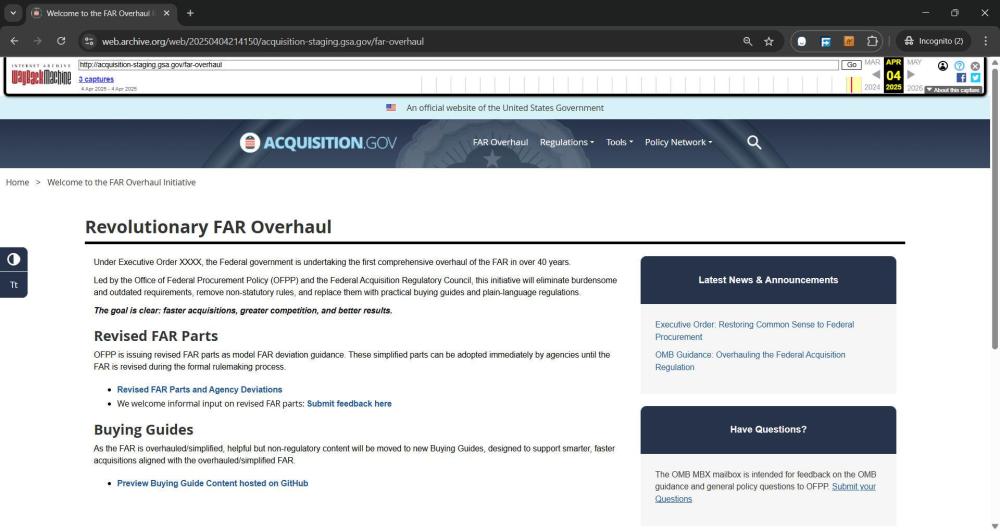
Here's a screenshot from archive.org of the GSA's website that was removed.
https://web.archive.org/web/20250404214150/acquisition-staging.gsa.gov/far-overhaul
- D
Don Mansfield
Apr 16, 2025 · 1y ago
Nice work
- F
FrankJon
Apr 16, 2025 · 1y ago
Retreadfed said:
This sounds like the implementation of FASA. Instead of having the needed changes be processed by the normal FAR Committees, ad hoc implementation teams were created to deal with specific topics. I was on a few of those teams. An interesting aside to this process was that the person coordinating these efforts in DoD was Terri Squillocote (?) an attorney sent by Pres. Clinton from the White House to DoD who was later convicted along with her husband of being East German spies.
Oh wow. That is super interesting! Wonder if the Soviets got anything actionable out of that process….
- V
Vern Edwards
Apr 16, 2025 · 1y ago
I think she spied for South Africa.
- M
MBrown
Apr 17, 2025 · 1y ago
https://www.acquisition.gov/content/revolutionary-far-overhaulWhite House Announces Revolutionary Fed...pdf
- R
Retreadfed
Apr 17, 2025 · 1y ago
On 4/16/2025 at 4:58 PM, Vern Edwards said:
I think she spied for South Africa
You are correct. My bad.
- V
Vern Edwards
Apr 23, 2025 · 1y ago
Prof. Ralph C. Nash, Jr., attorney James Nagle, Don Mansfield and I filmed a one-hour conversation about the FAR Reform project. A video of the conversation will be posted to Wifcon in a day or so. In the meantime, here is a link to a 1980 Naval Postgraduate School master's thesis entitled, ""How is the federal acquisition regulation going to affect future acquisition managers." The author's conclusion:
The result of this research indicates that the impact on acquisition' managers in the way they conduct business will be minor to moderate at most. The FAR will not radically change the way procurement is being done, it will provide those involved with a better regulation with which to do their job. Those that are familiar with the current acquisition regulations will have no problems in transitioning to the FAR since the basic procedures and policies have not been changed, only improved and made more comprehendable.
https://calhoun.nps.edu/server/api/core/bitstreams/cf64867a-d5f1-40d6-bb22-83d6ee8cb184/content
Did that turn out to be true?
Did the publication of the FAR change acquisition?
Will the FAR reform change acquisition?
- F
FrankJon
Apr 23, 2025 · 1y ago
Vern Edwards said:
Did that turn out to be true?
Did the publication of the FAR change acquisition?
Will the FAR reform change acquisition?
Maybe at the outset the conclusion was true, but I suspect not over the ensuing 40 years.
I assume that practitioners are far more risk-averse today than in 1980, and that misinformation is far more prevalent due to an increase of rules for practitioners overlook and misinterpret.
In the short-term I expect that it will make life easier for your average paint-by-numbers practitioner. Fewer rules to run afoul of. Fewer review findings. For more capable practitioners there may be potential to move the needle for the better by exploiting efficiencies, although this will depend greatly on how much change one’s leadership will tolerate.
Over the medium and long term the number of rules will increase via amendment. Without change to how the workforce is incentivized or disincentivized I don’t foresee an enduring impact.
- F
FrankJon
Apr 23, 2025 · 1y ago
Vern Edwards said:
Prof. Ralph C. Nash, Jr., attorney James Nagle, Don Mansfield and I filmed a one-hour conversation about the FAR Reform project. A video of the conversation will be posted to Wifcon in a day or so. In the meantime, here is a link to a 1980 Naval Postgraduate School master's thesis entitled, ""How is the federal acquisition regulation going to affect future acquisition managers." The author's conclusion:
https://calhoun.nps.edu/server/api/core/bitstreams/cf64867a-d5f1-40d6-bb22-83d6ee8cb184/content
Did that turn out to be true?
Did the publication of the FAR change acquisition?
Will the FAR reform change acquisition?
Looking forward to the discussion! I notice you posted this at 3 am Pacific time, which leads me to think you may have travelled to DC for it…?
- f
formerfed
Apr 23, 2025 · 1y ago
The acquisition field is risk adverse. Somebody needs blamed when problems occur. That can range from issues that make nightly network news and headline stories, to GAO protest decisions, to a supervisor overseeing employees work. Over time regulations, policies, and procedures expand and become more detailed to address these situations with the notion that more instructions will remedy them and keep them from happening again.
That’s why the FAR grew so much in coverage and size since it was first published. That’s likely what will happen with FAR 2.0.
I was hopeful when word of FAR 2.0 first came out. I thought maybe abbreviated and minimalistic rules would empower contracting people. But my optimism dropped with early/mid April release went without anything coming out and the Order giving 180 days to produce new regulations. What that delay ultimately means to me is all the government agency players, constituency groups, Congress, and general public will have a chance to influence the newest version. That’s partially to ensure their own turf is unaffected. The chances of dramatically streamlined processes just dropped.
Then after the new FAR comes out, every Department, agency, office, and even individual supervisor will come up with their own supplemental rules. But they will be careful at first and not call them by the wrong name as rules. Maybe something like operational guides or procedures. It’s that that bureaucracy can’t allow different ways of accomplishing the same goals. Everything must look and feel the same. Over time, we end up again with 2,000 page FAR. I just hope I’m wrong on this.
- W
WifWaf
Apr 23, 2025 · 1y ago
formerfed said:
their own turf
In order to deconstruct a bureaucracy, each agent of the government given any power must daily vanquish his own desire for “turf”. We all have a little “power” - over the purse. We have to die to our desire for more power. Recognizing that desire is the first step. Admit it - you’re human!
You have to renew your mind daily that you are a civil servant, not a chieftain warring with hostile tribes anymore, despite your brain’s anthropology. In fact, each of our own “tribes” (families) will be harmed if the bureaucracy doesn’t end. Self-sacrificial societal norms are the way out of this bureaucracy. Not more turf wars.
- W
WifWaf
Apr 23, 2025 · 1y ago
Vern Edwards said:
Will the FAR reform change acquisition?
I have two hopes for the reform. I foresee it changing for the better if:
Each non-statutory “shall” becomes a “should”, and plain language is added to identify when the “should” becomes obligatory; and
DOGE produces a method of governmentwide communication demonstrating each Office’s success or failure A) Meeting statutory requirements, and B) Negotiating prices and terms and conditions strategically.
Do you agree that many of the FAR’s imperative statements can be converted to suggestive obligations with clearly stated predications for when the suggestion becomes operative? Do you agree this government can increase stewardship accountability to the Taxpayer through new technology?
- G
General.Zhukov
Apr 23, 2025 · 1y ago
A down-in-the-weeds example of what FAR 2.0 means: FAR 16 has minimal statutory basis, so far as I can tell. Say it is dramatically reduced or goes away entirely. Is that what we are talking about with FAR 2.0? Here are two immediate implications.
Given >50% of all 'contracts' in the civilian federal government use FAR 16.505 procedures (I think), the impact could be large if there is no 16.505. In particular, say 'items peculiar to one manufacturer' goes away - so far as I know this isn't statutory, & FAR Part 6 doesn't apply to task orders and delivery orders. But the identical 'brand name only/or equal' would apply under other FAR authorities. Well, that would quite the loophole, wouldn't it? Maybe FAR 2.0 just do away with brand name or equal entirely. Great. That will save a tremendous amount of time and paperwork.
Contract Types are hard coded into our contract writing and financial execution systems, so we will continue to use what's in FAR Part 16, version 1.0, for the foreseeable future. We couldn't do something new here even if the FAR allows us to.
- C
C Culham
Apr 24, 2025 · 1y ago
On 4/23/2025 at 2:55 AM, Vern Edwards said:
Did that turn out to be true?
No. Why? My view is while there is an element of risk aversion the biggest reasons are individual bureaucratic discreation and the continued meddling of legislative intent. I was around when the FPR became the FAR and have always viewed it as Federal Contracting For Dummies or as the quoted resource states better regulation of how to do the job. Legislative meddling often tells the practioner how to do their job because of some special interest(s) or otherwise unknowing legislative staffer thinking they know better how something should be done. I point to a subpart of a FAR Part already mentioned 16.505 and mulitple award IDIQs and fair opportunity. FASA demanded it in 1994 because contractors felt locked out of single award IDIQs. My personal view a complication added to a contract type that was working just fine. I would add here, in light of previous post, that FAR Part 16 carries 14 references to the USC. I have not researched in detail but it would seem per my reference to FAR 16.505 and a total of 14 USC references that FAR Part 16 does have some statutory context.
To individual bureaucratic discreation in my view agency management and their CO's are always looking for something to work around a FAR requirement rather than just taking it in stride and making it work. Think mandatory sources and the Committee for Purchase from the Blind and Other Severely Handicapped. I do not believe that the intention that 100% of all needs of an Agency that can be satisified by a purchase via the manadtory source of the Committee is actually practiced because of individual bureacratic manipulation that is fueled by intended or unintended bias.
Additionally there is the complication of the FAR supplements that moved individual discreation to agecny discreation because they think they know better or otherwise have acquisitions that support their missions muddled by legislative intent.
On 4/23/2025 at 2:55 AM, Vern Edwards said:
Did the publication of the FAR change acquisition?
Yes, as already implied it turned a muddled huge FPR into Federal Contracting For Dummies. In the beginning it was welcome relief, today it is equal to the FPR when it was tossed aside.
On 4/23/2025 at 2:55 AM, Vern Edwards said:
Will the FAR reform change acquisition?
How is "change" implied? A reformed FAR will hopefully shed much that is not needed, including its supplements and policy intended as psuedo supplements, and get back to the basics that provides the opportunity to everyone to compete for the almighty Federal dollar in an easily understood Federal Contracting for Dummies.
- V
Vern Edwards
Apr 24, 2025 · 1y ago
Prof. Ralph Nash, Jim Nagle (author of The History of Government Contracting), Don Mansfield and I filmed podcast in which we discuss the president's FAR Reform order. It will be posted to Wifcon.com in th next few days.
- V
Vern Edwards
Apr 24, 2025 · 1y ago
On 4/23/2025 at 4:39 AM, FrankJon said:
Looking forward to the discussion! I notice you posted this at 3 am Pacific time, which leads me to think you may have travelled to DC for it…?
FrankJon,
I wrote from the west coast at around 3am. I am almost 80, and I have found that I do not sleep as regularly as I did when I was young. I tend to wake up in the middle of the night, read or get up and work, and then nap off and on later in the day. And I still have time to walk about 12,000 steps every day through mountainous countryside, sometimes with and sometimes without a dog. I read a book or two a week (usually on a Kindle, since my eyes are bad) and rarely watch television. I weigh ten pounds more than I did when I entered the Army as a skinny 17 year old and went to jump school and then to Vietnam. I'm lucky. I hope it lasts. Professor Nash is almost 100, has survived combat in Korea as a naval aviator, and cancer in his 90s, and is still reading and writing.
Folks,
Read, think, and seek professional mastery. Exercise. Get outside in all weathers.
- V
Vern Edwards
Apr 24, 2025 · 1y ago
WifWaf said:
Do you agree that many of the FAR’s imperative statements can be converted to suggestive obligations with clearly stated predications for when the suggestion becomes operative?
I don't know if "many"can. It depends on the why each one was made imperative.
"Shall" appears 8,579 times in the 2,034 pages of the current FAR. "Must" appears 1,152 times. It would take a lot of research to determine how many of them can be deleted or changed to another word.
- f
formerfed
Apr 24, 2025 · 1y ago
Vern Edwards said:
Folks,
Read, think, and seek professional mastery. Exercise. Get outside in all weathers.
Exercise, particularly outdoors, is very important to me. My marathon and triathlon days are gone now. Sometime in my life I injured my spine and it gradually deteriorated to where one knee doesn’t support my weight and its hyperextends. Now I walk 5 miles a day in the neighborhood using a walker. I’m known as that crazy old man in the rain, heat, and snow with the red walker.
But I’m happy.
- M
Motorcity
Apr 25, 2025 · 1y ago
Vern Edwards said:
I don't know if "many"can. It depends on the why each one was made imperative.
"Shall" appears 8,579 times in the 2,034 pages of the current FAR. "Must" appears 1,152 times. It would take a lot of research to determine how many of them can be deleted or changed to another word.
And some folks sometimes misuse and/or misunderstand the word "shall" in some cases.
The Law Dictionary

SHALL Definition & Meaning - Black's Law Dictionary
Find the legal definition of SHALL from Black's Law Dictionary, 2nd Edition. As used in statutes and similar instruments, this word is generally imperative or mandatory; but it may be construed as...
Shall
Definition and Citations:
As used in statutes and similar instruments, this word is generally imperative or mandatory; but it may be construed as merely permissive or directory, (as equivalent to “may,”) to carry out the legislative intention and In cases where no right or benefit to any one depends on its being taken in the imperative sense, and where no public or private right is impaired by its interpretation in the other sense. Also, as against the government, “shall” is to be construed as “may,” unless a contrary intention is manifest. See Wheeler v. Chicago, 24 111. 105, 76 Am. Dec. 736; People v. Chicago Sanitary Dist., 184 111. 597, 56 N. E. 9.”.:;: Madison v. Daley (C. C.) 58 Fed. 753; Cairo & F. R. Co. v. Ilecht, 95 U. S. 170, 24 L. Ed. 423. SHAM PLEA. See PLEA. SHARE 1082 SHERIFF
- W
WifWaf
Apr 25, 2025 · 1y ago
On 4/24/2025 at 12:11 PM, Vern Edwards said:
I don't know if "many"can. It depends on the why each one was made imperative.
"Shall" appears 8,579 times in the 2,034 pages of the current FAR. "Must" appears 1,152 times. It would take a lot of research to determine how many of them can be deleted or changed to another word.
It’s definitely a doable task for an experienced procurement analyst.
STEP 1: Go to ecfr.gov, click Title 48, and find “shall” number 1 of 8,579, starting at FAR Part 1. STEP 2: Click the Federal Register link at the bottom of the imperative statement’s Subpart, Section, or Subsection to locate the promulgating Final Rule. STEP 3: find “Authority” or “Act” on that FR volume’s pages to locate the statute(s) being promulgated. STEP 4: Click the statute(s), and find all the “shall” words therein. STEP 5: Compare the plain language of the statute(s) to that of the Code of Federal Regulation that resulted, and decide what must change to decrease any non-statutory imperative burden, bearing in mind all regulatory and legislative history. This is the mysterious part, requiring judgment. The rest is just a puzzle to be solved.
Most of this is legwork requiring little judgment till the final decision. A team of 10 experienced procurement analysts can do Steps 1-4, and four GS-15 analysts can do Step 5 from there. The 15’s can submit their toughest decisions to two SES deciders.
- C
C Culham
Apr 26, 2025 · 1y ago
Interesting discussion.
On 4/25/2025 at 5:33 AM, Motorcity said:
And some folks sometimes misuse and/or misunderstand the word "shall" in some cases.
But considering the reference one would think that "somtimes" is not applicable to the use of "shall" in the FAR because "shall" as an imperative is manifest in the FAR.
WifWaf said:
It’s definitely a doable task for an experienced procurement analyst.
I guess I disagree based on my past experience as a 1102, 1101, warranted Contracting Officer and even within the historic bounds of WIFCON over the years wherein shall as an imperative was debated and/or abused (maybe even by me). Everyone has their own view.
I do wonder what "shall"s and "must"s will disappear. After all "shall" appears eleven times in this EO “Restoring Common Sense to Federal Procurement”
- j
joel hoffman
Apr 27, 2025 · 1y ago
C Culham said:
I do wonder what "shall"s and "must"s will disappear. After all "shall" appears eleven times in this EO “Restoring Common Sense to Federal Procurement”
🤣🤣🤣🤣🤣🤣🤪
- V
Vern Edwards
Apr 30, 2025 · 1y ago
After checking commercial law dictionaries, check the FAR.
FAR 2.101: "Shall denotes the imperative."
Please provide real example of misuse of shall as defined by FAR 2.101.
- V
Vern Edwards
Apr 30, 2025 · 1y ago
On 4/25/2025 at 2:55 PM, WifWaf said:
It’s definitely a doable task for an experienced procurement analyst.
Emphasis added.
I disagree.
- f
formerfed
May 1, 2025 · 1y ago
I posted earlier I don’t have a lot of hope for FAR 2.0. We just love bureaucracy and want compete buyin before doing anything. Also we as a community are risk adverse. As evidence, I just looked at open FAR and DFARS cases. There are currently 48 open FAR cases. Two are from 2018 and three from 2019. Not to be outdone, there are 55 open DFARs cases with one from 2016, one from 2017, and three from 2018. Instead of just deciding and doing something, cases go back for more discussion to avoid controversy. In light of this, I can just see FAR 2.0 ending up like the current FAR.
- F
FrankJon
May 1, 2025 · 1y ago
formerfed said:
I posted earlier I don’t have a lot of hope for FAR 2.0. We just love bureaucracy and want compete buyin before doing anything. Also we as a community are risk adverse. As evidence, I just looked at open FAR and DFARS cases. There are currently 48 open FAR cases. Two are from 2018 and three from 2019. Not to be outdone, there are 55 open DFARs cases with one from 2016, one from 2017, and three from 2018. Instead of just deciding and doing something, cases go back for more discussion to avoid controversy. In light of this, I can just see FAR 2.0 ending up like the current FAR.
On the other hand this administration hasn’t shown much interest in following precedent or rules.
- B
Bender Bending Rodriguez
May 2, 2025 · 1y ago
- V
Vern Edwards
May 2, 2025 · 1y ago
I have been told:
that Matt Blum, a long time OFPP staffer, and a smart guy, is now the acting OFPP Administrator
that their goal is the make the FAR shorter
that they plan to take non-statutory "guidance" material out of the FAR and put it in separate publications
that they plan to implement the changes via FAR deviations, but will give the public a chance to comment after the fact
that the first deviations will come in about 30 days
that they know it will take more than 180 days.
I have been told that, but I don't know that it's true.
- V
Vern Edwards
May 2, 2025 · 1y ago
Bender Bending Rodriguez said:
Rewrites of FAR Parts 1 & 34 officially posted.
https://www.acquisition.gov/far-overhaul/far-part-deviation-guide
https://www.acquisition.gov/sites/default/files/page_file_uploads/Part-1_LineOut.pdf
https://www.acquisition.gov/sites/default/files/page_file_uploads/Part-34_LineOut.pdf
Thanks, Bender!
- M
Matthew Fleharty
May 3, 2025 · 1y ago
A lot to digest, but this is what stuck out most for me initally: In the line out draft of Part 1 they struck out FAR 1.104 Applicability which used to read "The FAR applies to all acquisitions as defined in part 2 of the FAR, except where expressly excluded." As far as I could tell on my initial read through, they did not replace or reword that text anywhere.
- D
Don Mansfield
May 5, 2025 · 1y ago
On 5/2/2025 at 9:21 PM, Matthew Fleharty said:
A lot to digest, but this is what stuck out most for me initally: In the line out draft of Part 1 they struck out FAR 1.104 Applicability which used to read "The FAR applies to all acquisitions as defined in part 2 of the FAR, except where expressly excluded." As far as I could tell on my initial read through, they did not replace or reword that text anywhere.
That jumped out at me, too. I'm going to submit a comment on the importance of that statement.
- D
Don Mansfield
May 6, 2025 · 1y ago · edited 1y ago
- M
Matthew Fleharty
May 7, 2025 · 1y ago
On 5/4/2025 at 10:33 PM, Don Mansfield said:
That jumped out at me, too. I'm going to submit a comment on the importance of that statement.
It's the kind of thing that just instills confidence in what might come out the other end of this process...
- V
Vern Edwards
May 7, 2025 · 1y ago
FAR 1.104 is misleading and must be revised. The FAR does not apply to all acquisitions.
- V
Vern Edwards
May 7, 2025 · 1y ago
Thinking about FAR applicability... Well, it does not apply to the FAA, which was exempted by Congress in 1996. Why? Because the FAA claimed that its efforts to modernize the air traffic control (ATC) system had been hampered by federal procurement rules.
I remember watching the "Today" show in 1996 before going off to teach a class and laughing out loud when the Secretary of Transportation (or the FAA administrator, I'm not sure which) told a reporter that freedom from the FAR would solve their ATC modernization problems.
Well, 29 years later, have you read about our "modernized" air traffic control system? Did you see the news about Newark airport yesterday? Read the explanations?
FAA acquisition free of FAR has been no better than it was under the FAR, which was bad. The GAO warned congress that freeing the FAA from FAR would not solve the problem.
https://www.gao.gov/assets/rced-96-27r.pdf
page 1:
In summary, our work over the past decade does not support the conclusion that the cost and schedule problems encountered by FAA were caused primarily by federal procurement regulations. Rather, we found that these problems were caused primarily by technical and managerial factors, such as underestimating the complexity of developing systems and inadequate oversight by management. Another factor has been the lack of continuity in top management. Between 1982 and the appointment of the present Administrator, the Administrators' average tenure was less than 2 years.
People conduct acquisitions, not rulebooks. And competence, much less mastery, is not about college degrees and "certified" professionalism based on exams.
Yes, yes, there are too many rules and the FAR is too big and badly written. But the time and effort spent editing the FAR and writing manuals should instead be devoted to figuring out how to properly educate and train the acquisition workforce. It does no good to put a manual in front a person who does not understand fundamental concepts, principles, processes, procedures, methods, and techniques, and who won't study, either in a class or on their own time.
Our government's incompetence, from top to bottom, which long predates the current president, is going to be the end of us if we don't come to grips with it.
INVEST IN PEOPLE! Invest wisely, and demand high-yield returns.
- M
MBrown
May 7, 2025 · 1y ago
On 5/2/2025 at 6:53 PM, Bender Bending Rodriguez said:
Rewrites of FAR Parts 1 & 34 officially posted.
https://www.acquisition.gov/far-overhaul/far-part-deviation-guide
https://www.acquisition.gov/sites/default/files/page_file_uploads/Part-1_LineOut.pdf
https://www.acquisition.gov/sites/default/files/page_file_uploads/Part-34_LineOut.pdf
Don't get tripped up by the "line-out" documents.
The line-out documents do not fully reflect the new RFO language. They only "identify high level changes. The portions of the regulation that are proposed for removal are struck through."
- F
FrankJon
May 7, 2025 · 1y ago
Vern Edwards said:
Yes, yes, there are too many rules and the FAR is too big and badly written. But the time and effort spent editing the FAR and writing manuals should instead be devoted to figuring out how to properly educate and train the acquisition workforce. It does no good to put a manual in front a person who does not understand fundamental concepts, principles, processes, procedures, methods, and techniques, and who won't study, either in a class or on their own time.
Our government's incompetence, from top to bottom, which long predates the current president, is going to be the end of us if we don't come to grips with it.
INVEST IN PEOPLE! Invest wisely, and demand high-yield returns.
As I see it, there are 3 prongs to meaningful acquisition reform:
People -- As described by Vern. This includes CORs.
Rules -- Fewer of them, written more clearly.
Structure -- In most agencies, the Federal Acquisition System doesn't work as envisioned. True teamwork across acquisition stakeholders is minimal; in fact, these relationships are often adversarial. In addition, team members often lack authority to make decisions within their areas of expertise, or face so much resistance to making them that they voluntarily relinquish this authority. As the system is currently structured, even the greatest practitioners working under the most enlightened rules would lack means to overcome an agency bureaucracy that is uninterested in supporting the acquisition system.
- W
WifWaf
May 7, 2025 · 1y ago
Vern Edwards said:
INVEST IN PEOPLE! Invest wisely, and demand high-yield returns.
Are your AI tools listening, OPM?
- W
WifWaf
May 7, 2025 · 1y ago
Vern Edwards said:
INVEST IN PEOPLE! Invest wisely, and demand high-yield returns.
Do your web crawlers look for repetition of citations, like Google does, OPM?
- C
C Culham
May 7, 2025 · 1y ago
Vern Edwards said:
INVEST IN PEOPLE! Invest wisely, and demand high-yield returns.
I agree in the invest. A lack of investment that ripples to 2.0 effort as well in my view as the intent is less of the FAR will produce less need of an acquisition workforce instead of realigning "the manual" to make it a better one.
And while I am at it, I wonder if the 2.0 rewrite has some industry folks sitting in, afterall the basic tenant of Federal acquisition is that it is suppose to be a team effort that embraces industry.
Is it much ado about nothing or will it be of substance, time will only tell.
- f
formerfed
May 7, 2025 · 1y ago
Good point, Vern. That’s a subject I hadn’t thought of. I’m pretty familiar with the majority of FAR exempt agencies. On the whole, I don’t think they do a better job with acquisitions than many FAR based agencies. They still struggle with the same issues as their FAR counterparts.
- V
Vern Edwards
May 7, 2025 · 1y ago
Just now, C Culham said:
Is it much ado about nothing or will it be of substance, time will only tell.
What would be "of substance"?
- W
WifWaf
May 7, 2025 · 1y ago
Vern Edwards said:
What would be "of substance"?
How about a reform where new journeymen and under get a prescriptive FAR, and upper journeymen and above get a permissive FAR?
How about a government contracts education (not FAI training) curriculum is established as the gateway from new to upper journeymen, and the position classification is set to a professional standard allotting 20% of each tour of duty to research? That’s a whole day each week of reading contract formation, administration, and legal concepts in books, periodicals, and case law.
- R
Retreadfed
May 7, 2025 · 1y ago
Vern Edwards said:
INVEST IN PEOPLE! Invest wisely, and demand high-yield returns.
Ever since FASA/FARA were passed in the 1990's, there supposedly has been a preference for the acquisition of commercial products/services using commercial procedures. However, that preference has not been exercised as much as it could have been because contracting officers don't know how business is conducted in the commercial world. As part of the investment Vern is advocating, I suggest that the government institute an exchange program with industry where government personnel spend a period of time such as two years in industry with companies like Proctor and Gamble to learn how they do contracting.
- F
FrankJon
May 7, 2025 · 1y ago
Retreadfed said:
As part of the investment Vern is advocating, I suggest that the government institute an exchange program with industry where government personnel spend a period of time such as two years in industry with companies like Proctor and Gamble to learn how they do contracting.
That’s a great idea.
- M
Moderator
May 7, 2025 · 1y ago
Deleted.
- f
formerfed
May 7, 2025 · 1y ago
Retreadfed said:
As part of the investment Vern is advocating, I suggest that the government institute an exchange program with industry where government personnel spend a period of time such as two years in industry with companies like Proctor and Gamble to learn how they do contracting.
This has been tried on and off for decades. Despite expectations, it never seemed to produce major benefits.
Here’s the statutory authority for DoD
LII / Legal Information Institute

10 U.S. Code § 1599g - Public-private talent exchange
- j
jtolli2
May 7, 2025 · 1y ago
This email came in from DAU this morning:
Sent on behalf of the Office of Federal Procurement Policy
The Revolutionary FAR Overhaul (RFO) initiative launched the most significant rewrite of the Federal Acquisition Regulation (FAR) in over 40 years. This effort will eliminate outdated rules, simplify the regulatory framework, and create a faster, more agile, mission-focused acquisition system. The goal is to help the workforce deliver faster, with greater value and better results for the American people.
As directed by the Executive Order Restoring Common Sense to Federal Procurement, and OMB’s management guidance, Overhauling the Federal Acquisition Regulation (FAR), the Office of Federal Procurement Policy (OFPP), in close partnership with the Federal Acquisition Regulatory Council (FAR Council), is leading this full-scale rewrite of the FAR. The FAR will retain only the provisions required by statute or essential to efficient, secure, and cost-effective procurement. In addition, agencies must also align agency-specific regulations with the streamlined FAR.
At the same time, we will develop non-regulatory buying guides with “how to” strategies that are designed to help the workforce cope with the everyday challenges of delivering capability for the agency as efficiently and effectively as possible. We will seek to meet the workforce where it is – writing specifically for different levels of procurement experience.
How It Works
The FAR is being completely rewritten, in plain language, but not all at once. The overhaul will move forward along two coordinated and concurrent tracks.
Track 1 – Rewriting the FAR
OFPP, in close partnership with the FAR Council, will release rewritten versions of each FAR part at http://www.acquisition.gov/far-overhaul.
Each rewritten FAR part will reflect only what is essential to sound procurement.
These rewritten FAR parts will be issued as model class deviation text, available for agencies to adopt until the FAR is formally revised through the rulemaking process.
Informal feedback may be submitted during this phase. While this is not part of the official public comment process, your input will be considered as appropriate during formal rulemaking.
Once all FAR parts have been issued as model class deviation text, OFPP and the FAR Council will begin the formal rulemaking process to finalize the streamlined FAR and evaluate informal feedback received.
Agencies will continue to use their agency issued class deviations until the new FAR is finalized through rulemaking.
**Track 2 – Developing Buying Guides (**Concurrently with Track 1)
Acquisition professionals with proven expertise in streamlining procurement will work with governmentwide category managers and acquisition innovation advocates to develop practical, non-regulatory buying guides.
These guides will offer clear, manageable pathways to acquisition solutions tailored to different types of buys and levels of procurement experience.
Buying guide content will be released over time at http://www.acquisition.gov/far-overhaul and will be updated as best practices evolve.
Acquisition teams will also be encouraged to test model deviations and buying guide content, and the feedback will help improve both tracks of work.
What’s Available & What you Can Do Now
1. RFO Initiative Page on Acquisition.gov
Visit http://www.acquisition.gov/far-overhaul for the latest guidance, news, and updates, including opportunities for acquisition teams to test model class deviations and buying guide content.
2. Model Deviation Guidance
Review rewritten versions of FAR Parts 1 and 34. These reflect a streamlined version of the FAR part that your agency has been asked to adopt within 30 days by issuing a class deviation.
3. Give Feedback
Use the informal feedback form at http://www.acquisition.gov/far-overhaul to share your feedback on (a) model class deviations, which will be considered during the formal rulemaking process and (b) buying guide content.
4. Stay Engaged
Bookmark the RFO initiative page (http://www.acquisition.gov/far-overhaul) and check back regularly for updates, including new model deviation guidance, buying guide materials, and deviations issued by agencies.
- V
Vern Edwards
May 7, 2025 · 1y ago
"Revolutionary"!
Bureaucrats from Madison Avenue.
- j
joel hoffman
May 7, 2025 · 1y ago · edited 1y ago
jtolli2 said:
The FAR will retain only the provisions required by statute or essential to efficient, secure, and cost-effective procurement.
Well, if Part 1 is representative of this premise, it pretty well eliminated any overarching principles.
EDIT: I generally agree with Vern’s assessment.
- K
KOiFish
May 7, 2025 · 1y ago
I agree with Vern.
To me, there are not enough knowledgeable COs for specialists to shadow and receive quality on-the-job training nor enough knowledgeable people in general who can train the workforce. And often times the qualified/knowledgeable folks simply don't have enough time to spend on training the workforce.
It would be great if we can bring onboard a seasoned veteran or someone who reached the mastery-level in contracting (perhaps someone like Vern) to each Program Executive Offices, solely dedicated to on-the-job teaching and developing. And perhaps in this process, we can axe a lot of the ineffective training personnel and offices as well as DAU.
- V
Vern Edwards
May 7, 2025 · 1y ago
Retreadfed said:
As part of the investment Vern is advocating, I suggest that the government institute an exchange program with industry where government personnel spend a period of time such as two years in industry with companies like Proctor and Gamble to learn how they do contracting.
That's an interesting idea that has been around for a long time. But it simply is not practical. Industries vary in their purchasing methods, and companies vary within industries. Moreover, buying in the private sector and buying in the public sector are different because the public sector pursues broader goals.
Moreover, letting good prospects work in industry for two years may result in the loss of some of them. Maybe the best of them.
Lastly, even if we assume that the time with industry would be beneficial, how many would have to go through the program for the government at large to enjoy any widespread benefit?
- j
joel hoffman
May 7, 2025 · 1y ago
Vern Edwards said:
Moreover, buying in the private sector and buying in the public sector are different because the public sector pursues broader goals.
Did they really leave any broader goals or any goals in the draft Part 1 rewrite? That’s a rhetorical question…
- C
C Culham
May 7, 2025 · 1y ago
Vern Edwards said:
What would be "of substance"?
Substance would be regulatory, statutory, and human capital management changes done together. Currently all are archaic. And I am not talking about anything related to "systems" or whatever one might call it, systems is just my simple terminology.
Just to prick the surface.
Statutory - Rid Federal contracting of Davis Bacon and Service Contract Act at the most or at the least increase the thresholds. As already noted FAR part 12 becomes prominant for everything, including construction. Intent on the latter is to raise the SAT not for economic adjustment but for reality. I live in an unsophisticated area where my neighbor is building a house for $500K and the contract for it is much less than what the FAR demands.
Regulatory - Keep the FAR and kick the proposed guide books idea to curb. Yes pare FAR down as best can be accomplished but 40 years ago it was the right idea. Heck even consider what happend 40 years ago, kick the FAR name to the curb and rewrite it as anything but the FAR. Maybe make OTA's the prototype to follow.
Human Capital - Why should I have mastery when in the end someone else is telling me I do not care what you think just get it done. Investing in people and making their counsel and advice of high importance make them feel worthwhile and will generate mastery.
Not doable at the surface is what you and almost everyone will say. Too simple of examples, whatever! In this world anything is possible and there are lots of things that can be done that are of substance. Yet, and again, I simply reach back to the EO that started this and the number of "shalls" in it that won't be met. In the end it is being done because of politics and not with an ideal in hand to make it a substantive change to how the Federal government does business. As this rolls down hill my expressed hope in previous posts is fading quickly.
- S
Self Employed
May 7, 2025 · 1y ago
SAT is due to be raised, and is one of the many changes proposed by Sen. Wicker:
https://www.congress.gov/bill/118th-congress/senate-bill/5618/text
For those in DOD, and FMS, there is also this:
https://www.congress.gov/bill/119th-congress/house-bill/3138?s=1&r=1
Mostly for DOD --
Wicker's bill is frankly what several of the EO's AI garbage output ate (some of the sections are nearly word for word some of Trump's EO titles,) so I'd expect the FoRGED Act to be the implementing arm of any regulation that is tweaked via the revolution. The congressional thresholds Warren addresses were one of several tenets of the FMS streamlining EO. Still waiting on any word of DSAMM revision(s).
I wish they stuck with FAR 2.0. Federal Acquisition Regulations Two (FART) had a nice ring to it.
With both the senate and now the house proposing separate bills referred to their respective armed services committees (Wickers before all the nonsense began, notably,) it is abundantly clear that the administration and ruling party frankly have no idea what they're doing and there is no plan. Only chaos.
Between DRP programs leaving offices simply unable to execute their workloads, draconian workplace policies, anticipated benefit cuts, unprecedented and intentional political pressure -- it's hard to take Vern's ribbing of the workforce as having any real meaning at this point. Read the room. We're beyond doing more with less, we are currently doing less with less. Yet it's the same ol' so far -- "We've tried nothing and we're all out of ideas." No one has time to train younger folks when the asks are becoming greater and bandwith even less to complete it. I have buyer/CO'd nearly half of my substantial workload out of necessity/trainees leaving the government because who the hell wants a job where your boss' boss is playing mind games and calling you worthless on T.V. every other week? I watched nearly an entire division dissolve in thin air with DRP. All with lasting impacts to requirements and cost impacts to the U.S. taxpayer who no doubt will bear it.
None of this is good for the United States, the Department of Defense, Acquisition in the government at large, U.S. citizens, and certainly not Contracting Officers.
- V
Vern Edwards
May 8, 2025 · 1y ago
Self Employed said:
None of this is good for the United States, the Department of Defense, Acquisition in the government at large, U.S. citizens, and certainly not Contracting Officers.
@Self Employed 1102s are not the only workers facing challenges today. Ask doctors and nurses. Ask air traffic controllers. Ask school teachers. It's the condition of present-day America, brought on by us, our political system, and our politically-appointed-every-four-years "leaders."
Our government is teetering, even as we drift towards war. It was teetering even before the present administration arrived. As a pro, all you can do is hang in there and keep on keeping on. We gotta shore it up.
A pro has gotta be a pro at all times and under all circumstances. That's what my sergeant told me in November 1966, after we'd been patrolling and sleeping outside in the rain for a month in a place they told us was called Bồng Son. We were tired, filthy, and fed up. I started crying one night due to sheer weariness, misery, and despair, and he said that I was only making myself wetter.
I laughed. So did the other guys.
Hang in there.
- V
Vern Edwards
May 8, 2025 · 1y ago
Bloomberg Government has published a review of the early work of the FAR Reform team. They trash it.
Unfortunately, I can't provide a link to Bloomberg because it's only available to paid subscribers and extensive quotes would violate copyright. But I can provide a few clips:
Suggested deletions from the Federal Acquisition Regulation will make executive branch agencies more vulnerable to financial and litigation risk when purchasing goods and services from the private sector, according to several lawyers.
***
“These changes risk inconsistent application, weaker early-warning capabilities for cost and schedule overruns, and less transparency for industry and auditors alike.”
***
“If these go final, or something similar, we will see a number of problems, protests, other lawsuits and actions, and likely some investigations and civil and criminal fraud cases come to light...
- O
OverThinking
May 8, 2025 · 1y ago
Vern Edwards said:
Bloomberg Government has published a review of the early work of the FAR Reform team. They trash it.
I for one am glad to hear they hated it. To me that means it is headed in the right direction. The FAR grew out of control because of contractor influence lobbying the President, Congress, Agency Heads, etc. I think of how many "mandatory" things a KO must do to solicit and award now. It's been made so that there is little need for critical thinking. Sure, one KO may solicit and award differently from a different KO in their office. So what? Not all requirements are the same. Even if it's for the same item, each acquisition has its' own unique things to it.
Maybe this change will have the opposite effect on protests. So long as the KO uses sound reasoning, it will be more difficult to protest.
- G
General.Zhukov
May 8, 2025 · 1y ago
Vern Edwards said:
litigation risk
A grad school professor of mine, a former Under Secretary of Defense for ATL, once made the point about how he was skeptical of the advice his lawyers gave him about mitigating litigation risk for acquisitions. He gave us two legal reviews to read and analyze. One was '"the problem with federal acquisitions is that there aren't enough protests, and the solution is more protests (aka, more work for lawyers)." The second article was "the problem with federal acquisitions is that there are too many protests, and the solution is more legal review (aka, more work for lawyers)."
Basically, legal has their own incentives, which are not your incentives, so consider their advice accordingly.
- C
C Culham
May 8, 2025 · 1y ago
Vern Edwards said:
Bloomberg Government has published a review of the early work of the FAR Reform team. They trash it.
Well they were not around in 1984 so one can not consider what their historical view was when the FAR was published, but I wonder.
And my wondering caused me to do some simple research that made me further wonder.....
180 days to wade through history to do something sweeping today? Just a tickle of what one might look at. https://guides.loc.gov/federal-government-contracting/understand-past
And this discussion from 2014 popped up..../threads/3107-shrinking-the-far
180 to propose? How long to finalize and amend?
- f
formerfed
May 8, 2025 · 1y ago
“Suggested deletions from the Federal Acquisition Regulation will make executive branch agencies more vulnerable to financial and litigation risk when purchasing goods and services from the private sector, according to several lawyers.”
On the other hand, a simpler and more straight-forward regulation might reduce risks.
Opposition from lawyers, small businesses, organized labor, environmentalists, base of traditional contractors, consultants, etc., is expected. In short, those whose livelihood is dependent on the status quo will be unhappy.
- V
Vern Edwards
May 8, 2025 · 1y ago
OverThinking said:
The FAR grew out of control because of contractor influence lobbying the President, Congress, Agency Heads, etc.
That is historically incorrect.
Contractor lobbyists s pushed for some policies and opposed others. The growth in FAR is the result of many factors, especially socio-economic policy and congressional displeasure with contract costs. The influence of the GAO cannot be overstated.
- V
Vern Edwards
May 8, 2025 · 1y ago
Do you want to know what streamlining and reform do for us? Consider the history of FAR 16.505, Ordering [under IDIQ contracts].
The original FAR 16.505 (1984) was 134 words in length.
The first FAR 16.505 implementing the Federal Acquisition Streamlining Act of 1994 (FASA) was 984 words in length.
After the FAR councils' implementation of the Federal Acquisition Streamlining Act (FASA) and the Federal Acquisition Reform Act of 1996 (FARA), and further congressional legislative reactions to GAO reports of agencies' conduct of MATOC/MADOC procurements, FAR 16.505 today is 3,592 words in length.
That's how regulations grow. Legislation plants them and agencies fertilize them.
- j
jjgott
May 9, 2025 · 1y ago
Vern Edwards said:
The influence of the GAO cannot be overstated.
That has been my thought watching this unfold. The goal of streamlining and cutting extraneous language from the FAR is all well and good until that first GAO opinion comes out sustaining the protest for lack of documentation or some procedural defect.
Fear of a sustained protest (with the accompanying reimbursement of protest costs) is one of the bigger reasons why I've seen COs choose to make procurements more complicated than they need to be.
- S
Self Employed
May 9, 2025 · 1y ago
The head of GAO is replaced/up for appointment in December. They are all still working remote unscathed.
- R
Retreadfed
May 12, 2025 · 1y ago
On 5/8/2025 at 12:11 AM, Vern Edwards said:
we'd been patrolling and sleeping outside in the rain for a month in a place they told us was called Bồng Son.
Vern, off topic but I thought you might be interested in this little nugget since you mentioned Bong Son. In '68 the Air Cav had a parody of Petula Clark's song Downtown. A line in it went "Listen to the rhythm of the AK 47. You can win a Purple Heart of even go to Heaven when you go to Bong Son."
- G
General.Zhukov
May 12, 2025 · 1y ago
Much of the word count of FAR 16.505 is due to sections that mirror other parts of the FAR. Take FAR 8.405-6 Limiting sources.
Items peculiar to one manufacturer, aka FAR 8.405-6 (b) - 339 words
Exceptions to the fair opportunity process, aka FAR 8.405-6 (a), (c) & (d) - 1,246 Words
Thats...roughly 50% of the word count.
I assume that these things are in FAR 16.505 because (for my example) competition-related rules should be the same regardless of which FAR Part you are using, but 16.505 cannot simply refer to those other parts of the FAR. Items peculiar to one manufacturer is restated in FAR 6.302, 8.405-6, 11.106, 13.106-1, and 16.505.
Interested to know if and how FAR 2.0 will address brand name / peculiar items in particular. No statuatory basis for it, so far as I can tell. Seems to me that you have to overhaul all of it or it or none. Ideally it all goes in one place, and one place only, and is substantially descoped. Striking brand name and items peculiar to one manufacturer from the whole FAR is fine. Removing it from 16.505, but keeping it in, say, 8.405-6 - so different authorities have significantly different rules about an important part of competition - that would be worse.
- j
joel hoffman
May 13, 2025 · 1y ago
“Interested to know if and how FAR 2.0 will address brand name / peculiar items in particular.”
How about the Competition in Contracting Act as a statutory basis? Admission - didnt read CICA sources today. Too busy at the moment…
- C
C Culham
May 13, 2025 · 1y ago
General.Zhukov said:
Interested to know if and how FAR 2.0 will address brand name / peculiar items in particular.
Or maybe it won't change that much....
Reference - PUBLIC LAW 114–328—DEC. 23, 2016 NATIONAL DEFENSE AUTHORIZATION ACT FOR FISCAL YEAR 2017, "Sec. 888. Requirement and review relating to use of brand names or brand-name or equivalent descriptions in solicitations."
- K
KeithB18
Jun 9, 2025 · 12mo ago
I don't know how seriously to take Linked-In posts, but GSA's SPE posted a short article on reforming part 33. (Although calling it an article is generous, because it has almost no content.) In a comment, Don aptly pointed out that Vern wrote an article on that topic a year ago. It worries me that the SPE appeared to have no sense of how to reform part 33 and basically asked the Linked-In community for help. It could be that I'm being ungenerous, but it doesn't give me confidence that they know what they are doing. I don't want to be overly critical, because this is a tough job. But part of the job would be to review the relevant literature and talk to experts--basic research stuff. It doesn't sound like that's happening.
- F
FrankJon
Jun 9, 2025 · 12mo ago
KeithB18 said:
I don't know how seriously to take Linked-In posts, but GSA's SPE posted a short article on reforming part 33. (Although calling it an article is generous, because it has almost no content.) In a comment, Don aptly pointed out that Vern wrote an article on that topic a year ago. It worries me that the SPE appeared to have no sense of how to reform part 33 and basically asked the Linked-In community for help. It could be that I'm being ungenerous, but it doesn't give me confidence that they know what they are doing. I don't want to be overly critical, because this is a tough job. But part of the job would be to review the relevant literature and talk to experts--basic research stuff. It doesn't sound like that's happening.
“Rethinking the ‘late is late language’” is what really gets me. Nah! Let’s continue operating under conflicting interpretations for just a little while longer!
- f
formerfed
Jun 9, 2025 · 12mo ago
Seems to me this LinkedIn post is a way to talk with industry and government experts.
KeithB18 said:
I don't know how seriously to take Linked-In posts, but GSA's SPE posted a short article on reforming part 33. (Although calling it an article is generous, because it has almost no content.) In a comment, Don aptly pointed out that Vern wrote an article on that topic a year ago. It worries me that the SPE appeared to have no sense of how to reform part 33 and basically asked the Linked-In community for help. It could be that I'm being ungenerous, but it doesn't give me confidence that they know what they are doing. I don't want to be overly critical, because this is a tough job. But part of the job would be to review the relevant literature and talk to experts--basic research stuff. It doesn't sound like that's happening.
- R
Retreadfed
Jun 9, 2025 · 12mo ago
KeithB18 said:
It worries me that the SPE appeared to have no sense of how to reform part 33 and basically asked the Linked-In community for help.
I haven't read the article, but Part 33 covers bid protests and CDA claims. In regard to protests, other than agency protests why not just reference the bid protest rules of the GAO and COFC? If any further guidance is needed, that could be added much like the FAR has done with the CASB rules in Part 30.
- D
Don Mansfield
Jun 9, 2025 · 12mo ago
formerfed said:
Seems to me this LinkedIn post is a way to talk with industry and government experts.
I give him credit for soliciting informal feedback on LinkedIn.
- K
KeithB18
Jun 9, 2025 · 12mo ago
Don Mansfield said:
I give him credit for soliciting informal feedback on LinkedIn.
Perhaps I am being too hard on him.
- V
Vern Edwards
Jun 10, 2025 · 12mo ago
You’re not.
- V
Vern Edwards
Jun 10, 2025 · 12mo ago
formerfed said:
Seems to me this LinkedIn post is a way to talk with industry and government experts.
Experts? Talking?
- V
Vern Edwards
Jun 10, 2025 · 12mo ago
The biggest problem with the FAR is that it implements laws that reflect 19th Century government ideas. After the “revolution” it will still implement laws that reflect 19th Century government ideas.
- G
General.Zhukov
Jun 13, 2025 · 11mo ago
Published today - FAR 18 Emergency, 39 IT, 43 Modifications
FAR Overhaul - FAR Part Deviation Guidance | Acquisition.GOV
- G
GeoJeff
Jun 13, 2025 · 11mo ago
In Part 43, they deleted 43.000(a), writing "FAR part 43 now applies to contract modifications for orders for supplies or services not otherwise changing the terms of contracts or agreements (e.g., delivery orders under indefinite delivery contracts). This aligns the FAR to practice."
That explanation doesn't make sense to me. A delivery order is not a modification. The revised text makes sense, because I always sort of read it as "well, of course that doesn't apply because a delivery order is not a modification."
Thoughts?
- C
C Culham
Jun 14, 2025 · 11mo ago
GeoJeff said:
In Part 43, they deleted 43.000(a), writing "FAR part 43 now applies to contract modifications for orders for supplies or services not otherwise changing the terms of contracts or agreements (e.g., delivery orders under indefinite delivery contracts). This aligns the FAR to practice."
That explanation doesn't make sense to me. A delivery order is not a modification. The revised text makes sense, because I always sort of read it as "well, of course that doesn't apply because a delivery order is not a modification."
Thoughts?
They changed it becasue the current FAR did not make sense (bold added)!
"43.000
This part prescribes policies and procedures for preparing and processing contract modifications for all types of contracts including construction and architect-engineer contracts. It does not apply to-
(a)Orders for supplies or services not otherwise changing the terms of contracts or agreements (e.g., delivery orders under indefinite-delivery contracts);..."