According to the Harvard Business Review, AI produces "Workslop"
Started by Vern Edwards · Dec 29, 2025 · 42 replies
- VOriginal post
Vern Edwards
Dec 29, 2025 · 5mo ago
From the Harvard Business Review Insider (which, unfortunately, is for subscribers only):
"Employees are using AI tools to create low-effort, passable looking work that ends up creating more work for their coworkers. On social media, which is increasingly clogged with low-quality AI-generated posts, this content is often referred to as “AI slop.” In the context of work, we refer to this phenomenon as “workslop.” We define workslop as AI generated work content that masquerades as good work, but lacks the substance to meaningfully advance a given task."
***
"As AI tools become more accessible, workers are increasingly able to quickly produce polished output: well-formatted slides, long, structured reports, seemingly articulate summaries of academic papers by non-experts, and usable code. But while some employees are using this ability to polish good work, others use it to create content that is actually unhelpful, incomplete, or missing crucial context about the project at hand. The insidious effect of workslop is that it shifts the burden of the work downstream, requiring the receiver to interpret, correct, or redo the work. In other words, it transfers the effort from creator to receiver."
***
"When asked about their experience with workslop, one individual contributor in finance described the impact of receiving work that was AI-generated: 'It created a situation where I had to decide whether I would rewrite it myself, make him rewrite it, or just call it good enough. It is furthering the agenda of creating a mentally lazy, slow-thinking society that will become wholly dependant [sic] upon outside forces.'”
- C
C Culham
Dec 29, 2025 · 5mo ago
Vern Edwards said:
slop
Thanks Vern. I struggled to find a place to offer this up when reading past WIFCON posts. But now I can. Back around December 15, 2025 this was announced - "Merriam-Webster names 'slop' as its 2025 word of the year." The "AI Overview" -
"Merriam-Webster's Word of the Year for 2025 is "slop," chosen for its surge in usage to describe low-quality, often AI-generated digital content like fake news, absurd videos, and propaganda flooding social media feeds. The word reflects a cultural moment where people are increasingly encountering vast amounts of mediocre, manipulative digital material, leading to significant interest and searches on Merriam-Webster's dictionary. "
- V
Vern Edwards
Dec 30, 2025 · 5mo ago
- V
Voyager
Dec 30, 2025 · 5mo ago
On 12/29/2025 at 11:16 AM, Vern Edwards said:
"When asked about their experience with workslop, one individual contributor in finance described the impact of receiving work that was AI-generated: 'It created a situation where I had to decide whether I would rewrite it myself, make him rewrite it, or just call it good enough. It is furthering the agenda of creating a mentally lazy, slow-thinking society that will become wholly dependant [sic] upon outside forces.'”
What's really scary is knowing that the individual quoted here will only live a finite life and then his replacement will have grown up consuming and sharing workslop.
I don't like leaving such depressing one-liners here. What can be done now by the current workforce to extend the life of corporate knowledge before we hand tasks requiring that prerequisite knowledge over to machines? I'm asking how to leave a legacy of thinking to people whom will not need to think.
- V
Vern Edwards
Dec 30, 2025 · 5mo ago
Voyager said:
What can be done now by the current workforce to extend the life of corporate knowledge before we hand tasks requiring that prerequisite knowledge over to machines?
Organizational knowledge is the cumulative knowledge of the individual members of the organization. Managers must impress upon their members that they are individually responsible to learn their jobs and strive for expertise. They should evaluate their members on their knowledge and performance.The members cannot wait for their employers to somehow provide it. Read (100 professional pages a week, minimum). Observe. Think. Learn. Adapt. Think again.
Congress should enact fewer laws and agencies write fewer regulations. Appoint fewer COs and select candidates on the basis of rigorous assessment of their ethics, knowledge, fidelity, judgment, and output quality. No exceptions. No handouts.
Make every CO appointment excepted service.
Assign each CO to manage a team of contract specialists.
Have high expectations.
Rigorously audit and reconsider each CO appointment annually.
Consider COs to be the acquisition equivalent of elite military special operators: people you know you can count on to pursue America's best interests honestly and fairly.
Is our federal government capable of establishing and maintaining a program like that???
(Should I send this to Pete Hegseth?)
- F
FrankJon
Dec 30, 2025 · 5mo ago
Voyager said:
I don't like leaving such depressing one-liners here. What can be done now by the current workforce to extend the life of corporate knowledge before we hand tasks requiring that prerequisite knowledge over to machines? I'm asking how to leave a legacy of thinking to people whom will not need to think.
I understand the existential dread over AI, but I think one of the fundamental aspects of technology is replace or augment human abilities. Each generation looks back and laments the experiences that subsequent generations are missing out on. I don't know your age, but surely you can see how this happened with the advent of the internet age in the 90s and with the smartphone in 2007. Can those of us who've basically grown up with these inventions "think"? Depends on who you ask. Point is, whether these advances are fundamentally helpful or harmful, I see AI as more of the same trend.
I'll leave you with a hopeful nugget I heard on a podcast yesterday: Apparently, when the ATM was invented, it was common wisdom that the bank teller profession would eventually be wiped out. Yet today, 60 years later, there are more bank tellers than ever before. Their scope of responsibilities just became much more sophisticated.
- V
Vern Edwards
Dec 30, 2025 · 5mo ago
FrankJon said:
Yet today, 60 years later, there are more bank tellers than ever before.
If you are basing that on Eric Schmidt's claims, you might want to investigate.
The reason ATMs led to more bank teller jobs is that ATMs allowed banks to open more branches, since each branch could be run with fewer tellers, which also meant banks could hire more tellers overall.
But now the number of branches is on the decline, “because of industry consolidation and technological change,” according to the Bureau of Labor Statistics. The federal agency predicts the number of bank teller jobs will decline to 480,500 by 2024, down from 520,500 in 2014.
https://www.vox.com/2017/5/8/15584268/eric-schmidt-alphabet-automation-atm-bank-teller
And ATMs are not AI as it is being developed today. Watch for robot tellers.
- F
FrankJon
Dec 30, 2025 · 5mo ago
Vern Edwards said:
If you are basing that on Eric Schmidt's claims, you might want to investigate.
https://www.vox.com/2017/5/8/15584268/eric-schmidt-alphabet-automation-atm-bank-teller
Yep. And based on a Google search, even your Vox article (written in 2017) significantly underestimated amount of decline to today. Apparently primarily due to online banking. Makes sense.
Oh well, @Voyager . I tried!
- V
Voyager
Dec 30, 2025 · 5mo ago
Vern Edwards said:
Appoint fewer COs and select candidates on the basis of rigorous assessment of their ethics, knowledge, fidelity, judgment, and output quality. No exceptions. No handouts.
So then, select managerial candidates incumbent upon their ability to discern B.S. in employees. By "B.S.", I mean:
On 12/29/2025 at 11:16 AM, Vern Edwards said:
content that is actually unhelpful, incomplete, or missing crucial context about the project at hand...[shifting] the burden of the work downstream, requiring the receiver to interpret, correct, or redo the work.
Or else the manager couldn't do the job of selecting CO candidates.
- V
Vern Edwards
Dec 30, 2025 · 5mo ago
Voyager said:
So then, select managerial candidates incumbent upon their ability to discern B.S. in employees.
I would let managers nominate candidates to be CO, but require that selection be made by a panel of senior executives (SES).
I would evaluate managers in part based on the quality of their nominees.
Why that approach? Because I want the CO position to be one of high prestige, authority, discretion, and responsibility.
Oh, and I would redesign the Certificate of Appointment.
- M
Motorcity
Dec 31, 2025 · 5mo ago
I think that a great deal of AI product and output can be pretty solid during these early stages of this sort of "revolution" with this technology. Keep in mind that the results rely on quality input from the user or requestor. The garbage in/garbage out mantra still applies here in every sense. If the requestor isn't specific and fairly detailed, then the results will be lacking to say the least. Lazy AI users will receive lazy results a great deal of the time. What is waiting for us down the line is a set of systems that keeps relearning and retooling, which takes slop and turns it to gold if allowed to do so. At the moment, a good system needs "good" users.
Various AI tools are used at my agency, at least for daily admin tasks. Frankly, management has encouraged the utilization of our AI platform. I have mentioned on here before about sitting through various demos of procurement-related AI tools and was pretty much blown away. I think we are going to see a huge shift to AI in the next 2 to 3 years in the fed procurement arena. We are going to see contract "writing" systems process most of the work that 1102s currently perform. While yes, there will be slop, but that can only last for so long. These tools tend to correct themselves and relearn much faster than humans can and do.
- V
Vern Edwards
Dec 31, 2025 · 5mo ago
Motorcity said:
We are going to see contract "writing" systems process most of the work that 1102s currently perform.
@Motorcity What do you mean by contract "writing"?
Most contract text is in governmentwide or agency-specific standard clauses in regulations. Those have been selected via automation for years, with varying results. AI could improve the speed and accuracy of those selections with the right input.
Then there are fill-in-the-blanks on standard forms. Ho-hum.
I guess you could say that developing contract line items is "writing." That involves some creativity. Have you seen a demonstration of AI doing that?
Contract-specific administrative/instructional text, although much of that is boilerplate or cut-and-paste.
Otherwise, the only real contract "writing" is the writing of acquisition-unique statements of work, performance work statements, and hardware and software specifications. But those are typically written by requirements personnel. That's a classic matter of technical/legal drafting. Not many people like writing and even fewer are good at it, so it's likely that requirements personnel will try AI, with results of varying quality and acceptability.
If you're talking about solicitations (RFPs, IFBs, RFQs), there are instructions and descriptions of evaluation factors. I suspect that those are mostly cut-and-pasties, but AI might do that.
What do you say? If contracting personnel are not competent at writing, would they be competent at reviewing and editing?
- C
C Culham
Dec 31, 2025 · 5mo ago
Motorcity said:
The garbage in/garbage out mantra still applies here in every sense.
My concern is what the garbage in is based on. By example my mind quickly races to the RFO and to date the varying adoption by deviation rate by agencies along with final FAR replacement in total. I struggle with how a requester can be specific and fully detailed in their request when considering the FAR, RFO, FAR Supplements and agency policy that would need to be included in a solicitation/contract. Humans are not perfect at doing it so I struggle that the tool created by humans, AI, can do it any better.
I struggle as well with the hidden impact. My life's view has been forever transformed by the multitude of windmills that line the ridges surrounding my home and the behemoth data centers now my neighbors that gulp water from the watershed that surrounds my home.
Connected?? In my view yes because it is all a part of the cost/benefit. Very simply stated. In the context of the discussion should it be more AI or an elite special contracting officer corps as the investment to make it (Federal acquisition) better or even best?
- M
Motorcity
Dec 31, 2025 · 5mo ago
Vern Edwards said:
What do you say? If contracting personnel are not competent at writing, would they be competent at reviewing and editing?
I think that contracting personnel are going to get very comfortable with whatever tool that can expedite processes. The processes can really be anything from clause selection, to drafting various documents and even solicitations. That being said, writing, reviewing, and editing is all one package, is it not?
- V
Vern Edwards
Dec 31, 2025 · 5mo ago
Just now, Motorcity said:
That being said, writing, reviewing, and editing is all one package, is it not?
I write for legal publications. I have written books and for periodicals. Several hundred publications. And writing, reviewing, and editing are not all "one package," if by that you mean the author has the final say on all three.
- V
Vern Edwards
Dec 31, 2025 · 5mo ago
Vern Edwards said:
If contracting personnel are not competent at writing, would they be competent at reviewing and editing?
My question for you was: "If contracting personnel are not competent at writing, would they be competent at reviewing and editing?"
Or should they just publish whatever AI gives them?
- V
Vern Edwards
Dec 31, 2025 · 5mo ago
Just now, Motorcity said:
I think that contracting personnel are going to get very comfortable with whatever tool that can expedite processes.
@Motorcity I hope that's not true. Because if it is, it doesn't say good things about "contracting personnel".
Expediting contractor selection and contract formation processes can lead to this:
https://www.gao.gov/products/b-423785
When a protester and agency disagree over the meaning of solicitation language, we will resolve the matter by reading the solicitation as a whole and in a manner that gives effect to all of its provisions. HumanTouch, LLC, B-419880 et al., Aug. 16, 2021, 2021 CPD ¶ 283 at 6. An interpretation is not reasonable if it fails to give meaning to all of a solicitation’s provisions, renders any part of the solicitation absurd or surplus, or creates conflicts. CACI, Inc.--Fed., supra at 9. Here, the Navy’s interpretation of the solicitation is not reasonable as it fails to give meaning to the solicitation’s provision expressly permitting offerors to propose TBD personnel.
Protest sustained. December 18, 2025. Merry Christmas! 🎄
What happened? The agency didn't understand the legal meaning of a key sentence in its own solicitation.
Look, Motorcity--AI is coming, whether we want it or not. Don Mansfield convinced me of that years ago. Used by the right people in the right way it may provide benefits. Probably will. But that remains to be seen, and we won't know for years, either the good or the bad.
I hope the incompetent know they are incompetent, but don't expect AI to be the cure for what ails them. I hope they work to fix themselves. They can do it if they try.
- f
formerfed
Dec 31, 2025 · 5mo ago
AI is most useful in its current stage of development for instructing preparation of items like SOW. It doesn’t produce a complete document by any means but it provides examples, instructions, and means to complete through iterative prompts.
I just played around with a SOW for help desk services. ChatGPT provided a simple template which is good to convey what’s needed. Gemini, which is what Google uses, is more informative and referred to examples from HHS and others. Claude gave the closest to a finished product.
If I were a CO and had a program office official who looked for help in drafting a SOW, AI can help. Of course, I would need to work closely as the document went through to final. The nice aspect is it avoids copying from other documents which may not be relevant.
- V
Vern Edwards
Dec 31, 2025 · 5mo ago
formerfed said:
I would need to work closely as the document went through to final.
@formerfed I don't understand. What does "work closely" mean? With whom or what would you work closely? Work to accomplish what?
- f
formerfed
Dec 31, 2025 · 5mo ago
@Vern Edwards I would work closely with the program official official who needed help in preparing the SOW. I always liked collaborating with program officials in preparing the SOW and other documents.
- V
Vern Edwards
Dec 31, 2025 · 5mo ago
- K
KeithB18
Jan 1, 2026 · 5mo ago
I have done some experiments with ChatGPT on SOWs and solicitations. It does okay with SOWs--they still need a fair bit of tailoring but I'd say it can produce a decent starting point. It cannot produce a reasonable solicitation yet, but there may be some series of prompts you could use to get a better output for the solicitation (I haven't explored it enough). So I think it will eventually be useful for those documents, but my rule of thumb is the more I relied on the AI tool, the more editing and oversight the document needs. It may not result in a reduction in effort, rather a shift in what you spend your effort on. I also wonder if this shift is even worth it...I guess we'll see.
That said, I have heard colleagues talk about using AI for evaluation, and that's where I get concerned. A government of the people needs people making decisions on behalf of the people. An idea I've been working on over the past few weeks is that we use contracting processes (and other government processes) to obscure the discretion given to deciders, mostly (probably? I'm still working through it) because deciders are afraid of criticism or don't want to decide.* To delegate decision making to AI is a further dereliction of duty.
*This works when you need the lowest priced #2 pencil, but treating the evaluation of a complex professional service as if it is a math problem to be solved isn't how qualitative decisions are made.
- V
Vern Edwards
Jan 1, 2026 · 5mo ago
Just now, KeithB18 said:
This works when you need the lowest priced #2 pencil, but treating the evaluation of a complex professional service as if it is a math problem to be solved isn't how qualitative decisions are made.
What do you mean by "qualitative decisions"?
How should such decisions be made?
- K
KeithB18
Jan 1, 2026 · 5mo ago
Vern Edwards said:
What do you mean by "qualitative decisions"?
How should such decisions be made?
This answer isn't going to be satisfying, because it is not satisfying to me. It's something I'm still working on.
I've been influenced lately by Michael Polanyi who wrote a lot about implicit and tacit knowledge. He wrote, "You know more than you can say." His works are kind of difficult, at least for me. I'm working in a basic and applied R&D context right now, and that line resonates with me when you have very experienced and top of their field scientists reviewing proposals. They may, quite rightly imo, rely on their intuition in selecting projects. Intuition doesn't necessarily lend itself to writing strengths and weaknesses.
Qualitative decisions are non-numeric judgments, and a lot of judgments are based on values. Values often operate in the background, implicitly. (There's a study on "Terror Management Theory" that showed that judges rule more harshly against people that violate the judges values when they are reminded of their own mortality beforehand: https://psycnet.apa.org/doiLanding?doi=10.1037%2F0022-3514.57.4.681. Which is just to point out that values can operate in unseen and strange ways.)
I'm not sure how to translate this into a normative rule. What I'm trying to do is what Oliver Wendell Holmes was doing in "The Path of the Law." Get the dragon out into the daylight, so that "you can count his teeth and claws, and see just what is his strength." I'm trying to understand what's really going on when procurement decisions are made, and adjust accordingly. Like, is there any other decision making context, in the entirety of human experience, that works like Federal procurement decisions do?
- V
Vern Edwards
Jan 1, 2026 · 5mo ago
Just now, KeithB18 said:
Qualitative decisions are non-numeric judgments, and a lot of judgments are based on values.
@KeithB18 I don't know you mean by that. Please explain.
Are you saying that qualitative value judgments cannot be described with numbers?
- K
KeithB18
Jan 2, 2026 · 5mo ago
Vern Edwards said:
@KeithB18 I don't know you mean by that. Please explain.
Are you saying that qualitative value judgments cannot be described with numbers?
The definition of "qualitative" via google is "relating to, measuring, or measured by the quality of something rather than its quantity." You can assign a number to quality, but I think the assigned number is, at least in part, an expression of the assigner's values.
- M
Motorcity
Jan 2, 2026 · 5mo ago
On 12/31/2025 at 1:07 PM, Vern Edwards said:
@Motorcity I hope that's not true. Because if it is, it doesn't say good things about "contracting personnel".
Expediting contractor selection and contract formation processes can lead to this:
https://www.gao.gov/products/b-423785
Protest sustained. December 18, 2025. Merry Christmas! 🎄
What happened? The agency didn't understand the legal meaning of a key sentence in its own solicitation.
Look, Motorcity--AI is coming, whether we want it or not. Don Mansfield convinced me of that years ago. Used by the right people in the right way it may provide benefits. Probably will. But that remains to be seen, and we won't know for years, either the good or the bad.
I hope the incompetent know they are incompetent, but don't expect AI to be the cure for what ails them. I hope they work to fix themselves. They can do it if they try.
See, AI isn't coming. It is already here and folks should accept it and learn to let AI work for us, rather than having us work for AI.
- F
FrankJon
Jan 2, 2026 · 5mo ago
KeithB18 said:
To delegate decision making to AI is a further dereliction of duty.
KeithB18 said:
The definition of "qualitative" via google is "relating to, measuring, or measured by the quality of something rather than its quantity." You can assign a number to quality, but I think the assigned number is, at least in part, an expression of the assigner's values.
I think you have it right. One of Vern's favorites, Decision Analysis for Management Judgment (Fifth Edition), states the following on page 4:
While we should not expect decision analysis to produce an optimal solution to a problem, the results of an analysis can be regarded as being 'conditionally prescriptive.' By this we mean that the analysis will show the decision maker what he or she should do, given the judgments which have been elicited from him or her during the course of the analysis. The basic assumption is that of rationality.
My takeaway is that, while AI can certainly help to elucidate our decision making processes in ways with which humans struggle, to protect the integrity of the process the value inputs and final decision must be human-determined.
KeithB18 said:
Like, is there any other decision making context, in the entirety of human experience, that works like Federal procurement decisions do?
I'm curious to know what you mean by this. Boiled down to its essence, I'm struggling to think of anything that makes a Federal contracting source selection decision unique from any other decision involving tradeoffs.
- M
Motorcity
Jan 2, 2026 · 5mo ago
KeithB18 said:
* To delegate decision making to AI is a further dereliction of duty.
I agree, but I think more people will rely on various AI tools to help offer options or various pathways and strategies to get to a decision.
- K
KeithB18
Jan 2, 2026 · 5mo ago
FrankJon said:
I'm curious to know what you mean by this. Boiled down to its essence, I'm struggling to think of anything that makes a Federal contracting source selection decision unique from any other decision involving tradeoffs.
When you bought your house (most people's largest purchase) did you:
Set evaluation criteria that could not change?
Ask for a written proposal from each house for sale without, potentially, even stepping inside the house yourself?
Have 3, 5, 7, or more extended family members review each house against the evaluation criteria and make a recommendation to you, as the selection authority?
Document the reasons you made your decisions and the tradeoffs you made?
(As an aside, when my wife and I started looking for our home, we thought we wanted three bedrooms and a basement. We bought a home with two bedrooms and no basement. We chose this house because it was very close to metro and a grocery store. Our initial evaluation criteria were incorrect! Happens all the time--people are not always very good at knowing what is important to them.)
What about when you picked your spouse? Did you write down the tradeoffs you made? (I hope not!)
Do you shop around to get a better deal on your dry-cleaning or just go to the most convenient one? I would posit that there are very few commercial, daily transactions where we make more than the most basic tradeoffs. Often they are only implicit: "I don't want to pay that price for that can of green beans."
So while it is superficially true that tradeoffs are made at the individual and government levels, the form those tradeoffs take is so significantly different that it constitutes a completely different thing.
- M
MediocreOG
Jan 2, 2026 · 5mo ago
Motorcity said:
See, AI isn't coming. It is already here and folks should accept it and learn to let AI work for us, rather than having us work for AI.
^This. I agree that we should expect more from the 1102 profession (and I'd argue that we should have been doing so for the past 15 years at least). There is an obvious need (that isn't really new) to add to Vern's description of how we should be setting expectations and hiring/developing our 1102 workforce: acquisition applications & tools technical knowledge and capability (including but not limited to using AI-based tools, agentic AI for rote tasks, or AI as an assistant, etc.). It's not enough to be an expert in federal acquisition. If we use the bank teller analogy described earlier, now is the time to consider the evolving roles of the practitioner and hiring manager, leaning in to the increased sophistication required to be effective. I've seen so many acquisition systems/application projects fail because those leading the charge for modernization don't understand the basics of the system they are trying to build or change, and the practitioners who DO are not brought in to inform how that system is developed or updated. Well-meaning IT experts brought in to make the changes don't know any better (they usually aren't acq-savvy) and end up building based on theoretical concepts that don't translate well to operations. This creates a lot of waste with mediocre (and sometimes systematically detrimental) results. The missing link is technical (IT) proficiency in the acquisition career field. I'm not talking coders and architects; I'm thinking more along the lines of folks who have a basic understanding of ITIL and are fluent enough to effectively describe their needs to those who work their magic in IT. Those who also understand the tools already available enough to effectively leverage them for acquisition purposes (think: the entire MS Suite of tools). I think those big failed projects are too often blamed for the shortcomings of the workforce, and that blame is sorely misplaced (linking back to Vern's spoon-feeding comment). Pre-AI I've seen enough "workslop" from folks who have been over-promoted and are very skilled in giving the appearance they know what they are doing; so this concept is nothing new. We need to raise our standards. AI will just be another (leatherman) tool in our toolbox.
- F
FrankJon
Jan 2, 2026 · 5mo ago
@KeithB18 in your earlier post you stated:
KeithB18 said:
I'm trying to understand what's really going on when procurement decisions are made, and adjust accordingly. Like, is there any other decision making context, in the entirety of human experience, that works like Federal procurement decisions do?
This sounds like you're questioning the decision process itself. But apparently you were referring to things like:
KeithB18 said:
Set evaluation criteria that could not change?
Ask for a written proposal from each house for sale without, potentially, even stepping inside the house yourself?
Have 3, 5, 7, or more extended family members review each house against the evaluation criteria and make a recommendation to you, as the selection authority?
Document the reasons you made your decisions and the tradeoffs you made?
With the exception of Bullet 1, I have a hard time seeing how these impact the decision in ways that are unique.
Bullet 1: Yes, the decision criteria are less malleable than what we find in pretty much any other life decision, but it's not true that they can't change. We would simply need to resolicit.
Bullet 2: This isn't referring to a rule or custom. Agencies base decisions on the wrong information all the time just as private companies and individuals do.
Bullet 3: Is this so different than telling family and friends what you value and asking for their input on a decision?
Bullet 4: Purely an administrative requirement.
KeithB18 said:
So while it is superficially true that tradeoffs are made at the individual and government levels, the form those tradeoffs take is so significantly different that it constitutes a completely different thing.
It seems like you're really comparing the rigor applied to a Government source selection decision vs. that applied to other decisions. To that, I'll refer back to Decision Analysis, which advises that for important decisions, we ought to be applying greater rigor than most of us actually do. Instead, most of us utilize heuristics that don't always serve us well.
- C
C Culham
Jan 2, 2026 · 5mo ago
FrankJon said:
Boiled down to its essence, I'm struggling to think of anything that makes a Federal contracting source selection decision unique from any other decision involving tradeoffs.
I struggle as well.
@KeithB18 I wonder with some very simple examples -
Where in the Federal procurement rules does it state that evaluation criteria can not change prior to final source selection?
House, maybe not during final evaluation but I have got to think that during what I will term market research. Would it be foolish to consider real estate listings to be similiar to GSA FSS ergo a purchase from an established listing of possiblities? Recent experience with one of my children and his wife as first time home purchasers, I did not step into any of the possibilities but they were shared via emails and I voiced thoughts.
Documentation maybe not as a formaility all the time but a mental exercise of the same decision processes. And by my own personal experience there might be the use of the old trick of a pros and cons list. Something I have used several times throughout my lifetime.
Legislated socio-economic demands are what sends Federal procurement down its unique path.
- V
Vern Edwards
Jan 2, 2026 · 5mo ago
KeithB18 said:
You can assign a number to quality, but I think the assigned number is, at least in part, an expression of the assigner's values.
What else would it be? Are you suggesting that value is an objective measure, probably true?
- V
Vern Edwards
Jan 2, 2026 · 5mo ago
Motorcity said:
See, AI isn't coming. It is already here and folks should accept it and learn to let AI work for us, rather than having us work for AI.
By "accept" do you mean we should uncritically take whatever AI gives us?
- V
Vern Edwards
Jan 2, 2026 · 5mo ago
FrankJon said:
I think you have it right. One of Vern's favorites, Decision Analysis for Management Judgment (Fifth Edition), states the following on page 4...
@FrankJon My man!!!
Someone has actually looked at a book I recommended. My professional life is not absurd, a la Sisyphus!
Seriously, Thank you!
- V
Vern Edwards
Jan 2, 2026 · 5mo ago
MediocreOG said:
AI will just be another (leatherman) tool in our toolbox.
I hate the phrase "tool in our toolbox." It's acquisition Madison Avenue𑁋something out of Contract Management magazine.
The most important tool in any human's "toolbox" is their mind. It's the tool we must hone, master, and learn to use effectively.
- K
KeithB18
Jan 2, 2026 · 5mo ago
Vern Edwards said:
What else would it be? Are you suggesting that value is an objective measure, demonstrable by proof?
What I'm trying to say is that there is a false expectation that the output of our evaluation and selection process is an objectively correct answer. We can change our processes in ways that make it more likely we've selected a correct answer (there could be many), and I've exchanged posts with you on ways I think we should do that--capabilities based assessments; oral presentations preferred to written responses, much of which I learned from reading your writings. But it won't get close unless we continually interrogate it, and also I don't think anyone here is suggesting otherwise. Maybe this isn't much of a radical position. I would say, however, I have recent experience that suggests some decision makers rely on the process as a way to avoid criticism and discretion.
To tie it back to the original subject of this thread--relying on process without being intensely critical of the process itself is similar relying on AI.
As an aside: Attaching a picture I took moments ago of decision books recommended by Vern. Can't say I've read either cover to cover, but I have referred to them over the years. To some extent we are all Camus' Sisyphus perpetually rolling the boulder up a hill.
- K
KeithB18
Jan 2, 2026 · 5mo ago
Here
KeithB18 said:
What I'm trying to say is that there is a false expectation that the output of our evaluation and selection process is an objectively correct answer. We can change our processes in ways that make it more likely we've selected a correct answer (there could be many), and I've exchanged posts with you on ways I think we should do that--capabilities based assessments; oral presentations preferred to written responses, much of which I learned from reading your writings. But it won't get close unless we continually interrogate it, and also I don't think anyone here is suggesting otherwise. Maybe this isn't much of a radical position. I would say, however, I have recent experience that suggests some decision makers rely on the process as a way to avoid criticism and discretion.
To tie it back to the original subject of this thread--relying on process without being intensely critical of the process itself is similar relying on AI.
As an aside: Attaching a picture I took moments ago of decision books recommended by Vern. Can't say I've read either cover to cover, but I have referred to them over the years. To some extent we are all Camus' Sisyphus perpetually rolling the boulder up a hill.
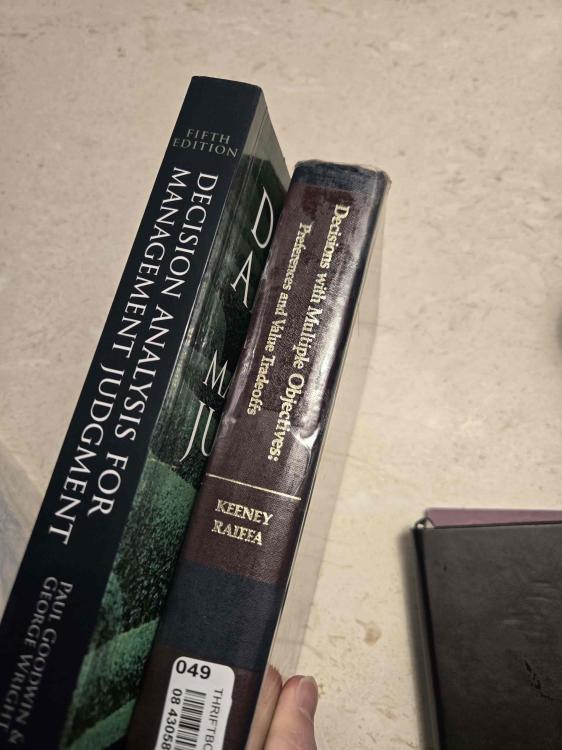
Here's the picture, anyhow.
- F
FrankJon
Jan 2, 2026 · 5mo ago
Vern Edwards said:
@FrankJon My man!!!
Someone has actually looked at a book I recommended. My professional life is not absurd, a la Sisyphus!
Seriously, Thank you!
Haha....Merry Christmas??
- V
Vern Edwards
Jan 2, 2026 · 5mo ago
Just now, KeithB18 said:
As an aside: Attaching a picture I took moments ago of decision books recommended by Vern. Can't say I've read either cover to cover, but I have referred to them over the years.
Thank you for that, Keith! You and FrankJon have given my new year a happy start. Now, if only I can survive being 80.
- M
MediocreOG
Jan 2, 2026 · 5mo ago
Vern Edwards said:
I hate the phrase "tool in our toolbox." It's acquisition Madison Avenue𑁋something out of Contract Management magazine.
The most important tool in any human's "toolbox" is their mind. It's the tool we must hone, master, and learn to use effectively.
@Vern Edwards Touché. It’s not the first time I’ve used corny catch-phrases and I’m sure it won’t be the last. I found my way to using that one because I was surrounded by folks who evangelized one PIL method or another as though the PIL is a panacea for all contracting ills. I was helping the program team understand that there are many paths to a solution. You are correct, as usual, sir …and you help make my point that tools will come and go, but the true resource is the human.
- M
MediocreOG
Jan 6, 2026 · 5mo ago
I came back here to drop a quick link to a short and relevant read: https://www.businessinsider.com/how-to-use-ai-without-losing-critical-thinking-leading-physicist-2025-12